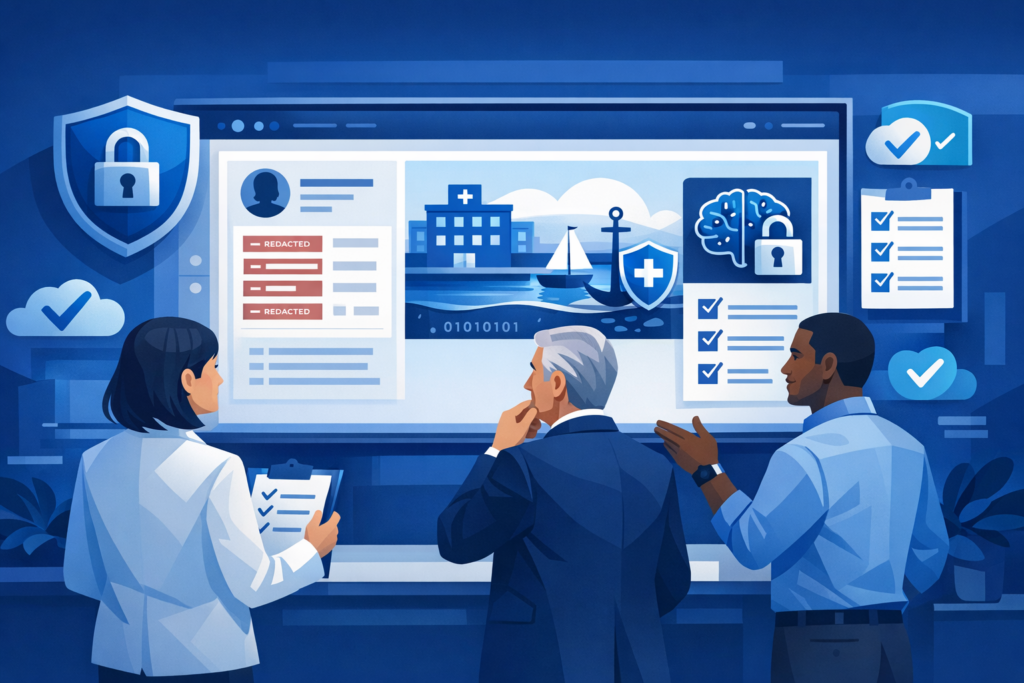
There’s a misconception circulating in healthcare leadership circles that using AI for medical coding automatically creates HIPAA compliance risk. It’s an understandable concern — any technology that touches clinical documentation raises legitimate questions about patient privacy. But the conversation too often stops at “AI plus clinical data equals risk” without examining whether the architecture actually involves protected health information at all.
The reality is more nuanced, and it depends entirely on how the system is designed. As we detailed in our white paper, “The Influence of Artificial Intelligence on Medical Coding and Auditing,” platforms that implement HIPAA Safe Harbor de-identification before any AI processing effectively remove the PHI from the equation. The Safe Harbor method, defined at 45 CFR § 164.514(b)(2), specifies 18 categories of identifiers that must be removed — names, dates of birth, Social Security numbers, medical record numbers, and so on. When those identifiers are stripped and replaced with standardized placeholders before the clinical text reaches an AI model, the data no longer meets the regulatory definition of PHI. The AI analyzes the clinical narrative without ever knowing who the patient is.
This doesn’t mean organizations can ignore compliance. Far from it. As of early 2026, neither CMS nor the OIG has issued comprehensive guidance specifically addressing AI-generated or AI-assisted medical codes. The regulatory landscape is evolving, and organizations deploying AI coding tools today are operating in an environment where some rules remain undefined. What is clear is that the billing provider is responsible for the accuracy of every claim submitted, regardless of the tools used to generate the codes. Vendors typically disclaim liability in their terms of service, which means the compliance risk stays with the organization — and that makes governance, validation, and audit trails essential.
The practical takeaway for healthcare leaders is this: don’t let HIPAA anxiety prevent you from evaluating AI coding solutions, but don’t skip the architectural due diligence either. Ask vendors exactly where PHI exists in their pipeline, whether de-identification happens before or after AI processing, what data is stored and for how long, and whether their cloud AI provider’s data processing agreement prohibits using your data for model training. The white paper provides a detailed framework for these evaluations. The organizations that get this right will be the ones that treat compliance as an engineering problem, not just a legal checkbox.