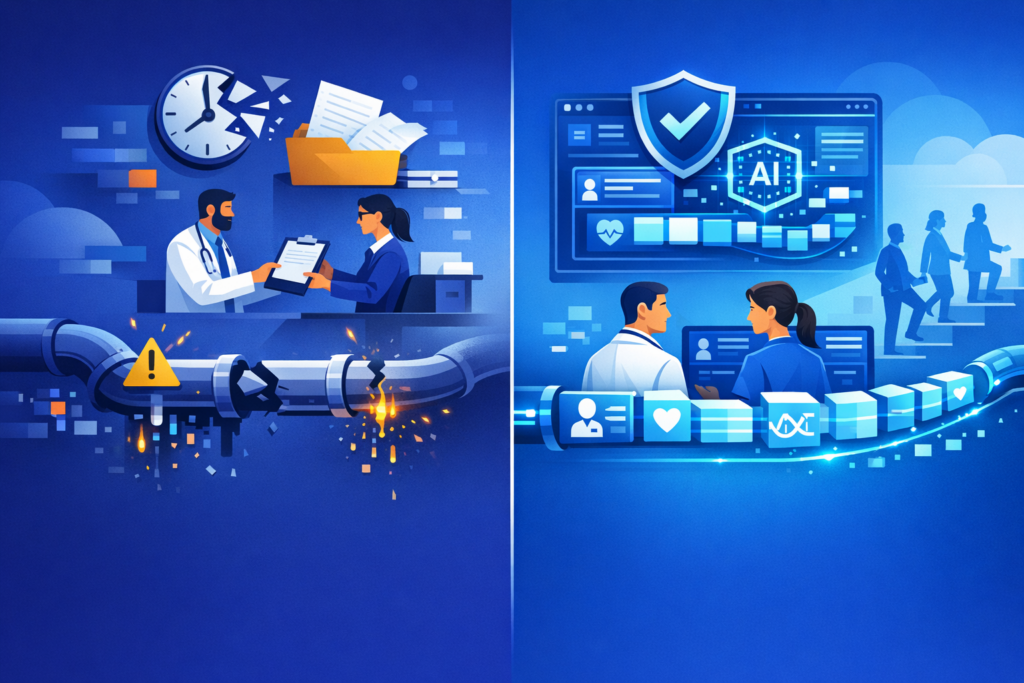
Everyone in healthcare IT talks about AI’s potential to transform medical coding. Far fewer people talk about the unglamorous reality that determines whether that transformation actually happens: how well the AI integrates with your EHR. You can have the most sophisticated natural language processing engine on the market, but if it doesn’t surface code suggestions at the right point in the coder’s workflow, if the data exchange is incomplete, or if the integration adds latency that disrupts clinical operations, the technology will fail in practice regardless of how well it performs in a demo.
This is one of the most underappreciated dimensions of AI coding deployment, and it’s a central focus of our white paper, “The Influence of Artificial Intelligence on Medical Coding and Auditing.” The fundamental decision organizations face is between embedded and bolt-on solutions. Embedded solutions — like Epic’s growing suite of ambient documentation and coding intelligence tools, Oracle Health’s AI offerings, or MEDITECH’s third-party partnerships — live inside the EHR interface the coder already uses. The advantage is workflow seamlessness: suggestions appear in context, there’s no application switching, and adoption barriers are lower. Bolt-on solutions from independent vendors often bring more sophisticated AI capabilities and faster innovation cycles, but they introduce integration complexity, potential latency, and additional vendor management overhead.
The interoperability layer matters more than most vendors will admit. FHIR R4 has become the predominant standard for modern EHR integrations, but the richness of the data available through FHIR varies significantly by vendor and implementation. Many AI coding solutions still require CCD or CDA feeds to access the full clinical narrative, and the completeness of those feeds directly affects AI accuracy. Then there’s the timing question: suggestions that appear before documentation is complete will be inaccurate, and suggestions that appear after the coder has already formed an opinion add friction without value. The white paper details how most implementations require iterative tuning to find the right balance, and that workflow design decisions are as important as the AI technology itself.
Perhaps the most critical factor is one that has nothing to do with technology at all: change management. Coders may view AI as a threat to their professional relevance, an unreliable tool, or a disruption to workflows they’ve spent years refining. The white paper’s composite case studies consistently show that organizations that treat AI implementation as a purely technical project and neglect the human dimensions underperform. Successful deployments require transparent communication about the role of AI, meaningful coder involvement in testing and feedback, comprehensive training, and visible organizational commitment to addressing issues as they arise. The EHR integration is the plumbing. Change management is what determines whether anyone turns on the faucet.